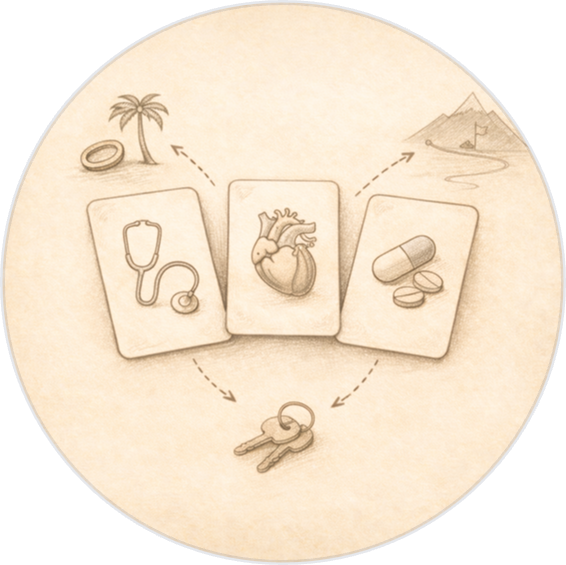
Understand
Students figure out what matters, what they need to know, and how to use the resources around them to actually understand it.
Start with your institution and follow a learning system built around the resources your school already provides.
The Product
PASS gives medical education institutions the ability to teach their incoming medical students how to use the study resources, practice questions, support, and curriculum they already provide, so students always know what to learn next and spend less time and effort on things that don't matter.
It is the first of its kind and the only medical education learning system that has successfully helped medical students reach high standards while making it easier to get there at the same time.
For medical students, PASS has helped them get better academic results while spending significantly less time studying.
For medical schools, the same system has helped increase incoming student retention, give faculty a chance to detect struggling students earlier, and help decrease remediation burden before things are already too late.
Real-World Use
WMOL PASS has already been successfully used in both one-on-one sessions with medical students and across multiple institutions for the last three years. It has numerous testimonials showing the effectiveness of the product from individual medical students. It also has a number of publications and emerging research data showing similar effectiveness when done through institutions.
Better grades with less time studying.
More time for life outside of school.
Less time worrying about falling behind.
Always knowing what to do next no matter the year.
Across multiple campuses, the data has shown PASS has helped:
Why Trust the System
The WMOL PASS System is the only medical education learning system that has been successful in helping medical students reach high standards while making it easier to get there at the same time.
The system has been tested and successfully used to complete both Step 1 and Step 2 licensing exams back-to-back, each within a five-month time period, while spending roughly a third of the preparation time per day compared with traditional timelines.
At the same time, the system still allowed for the successful completion of a 100-mile ultramarathon while maintaining healthy amounts of sleep, nutrition, mental health, and a life outside of medical education.
The system has been tested and succeeded even when your time, energy, and emotional bandwidth are limited.
The Learning System
Students are taught a four-part system that teaches them how to use all of the resources provided by your institution in the most efficient manner.
Students figure out what matters, what they need to know, and how to use the resources around them to actually understand it.
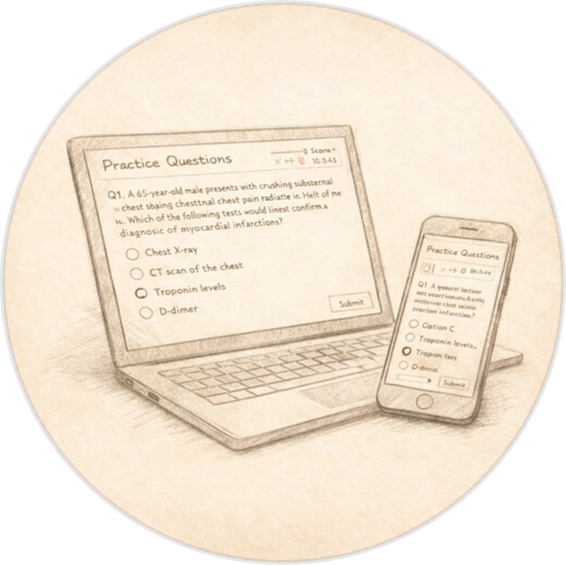
Students turn that understanding into something they can retrieve and use later instead of repeatedly starting over.
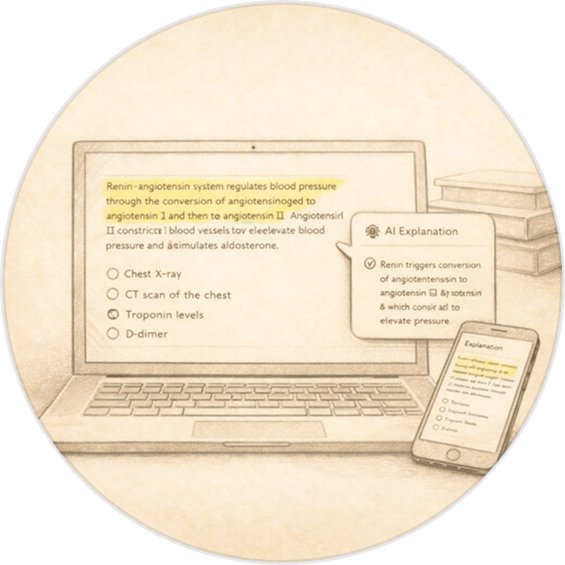
Students use practice questions to test what they actually know and find the parts that still need work.
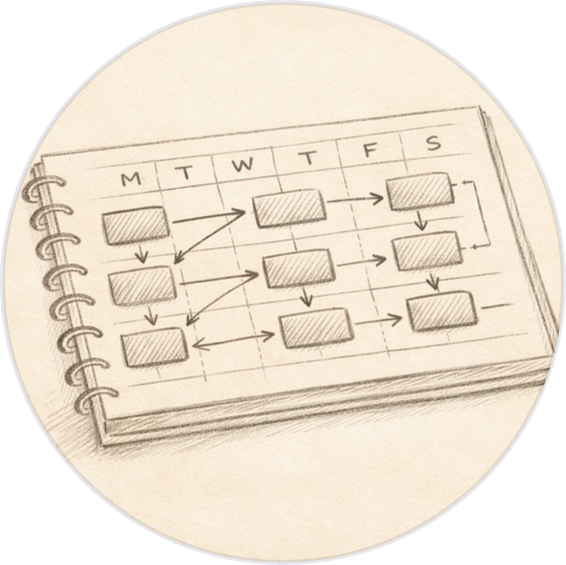
Students learn how to keep the system working as the amount of information, pressure, and responsibility increases.
The Four-Week Program
Each week teaches a different part of the system, then gives students a chance to use it before the full pressure of medical school begins.
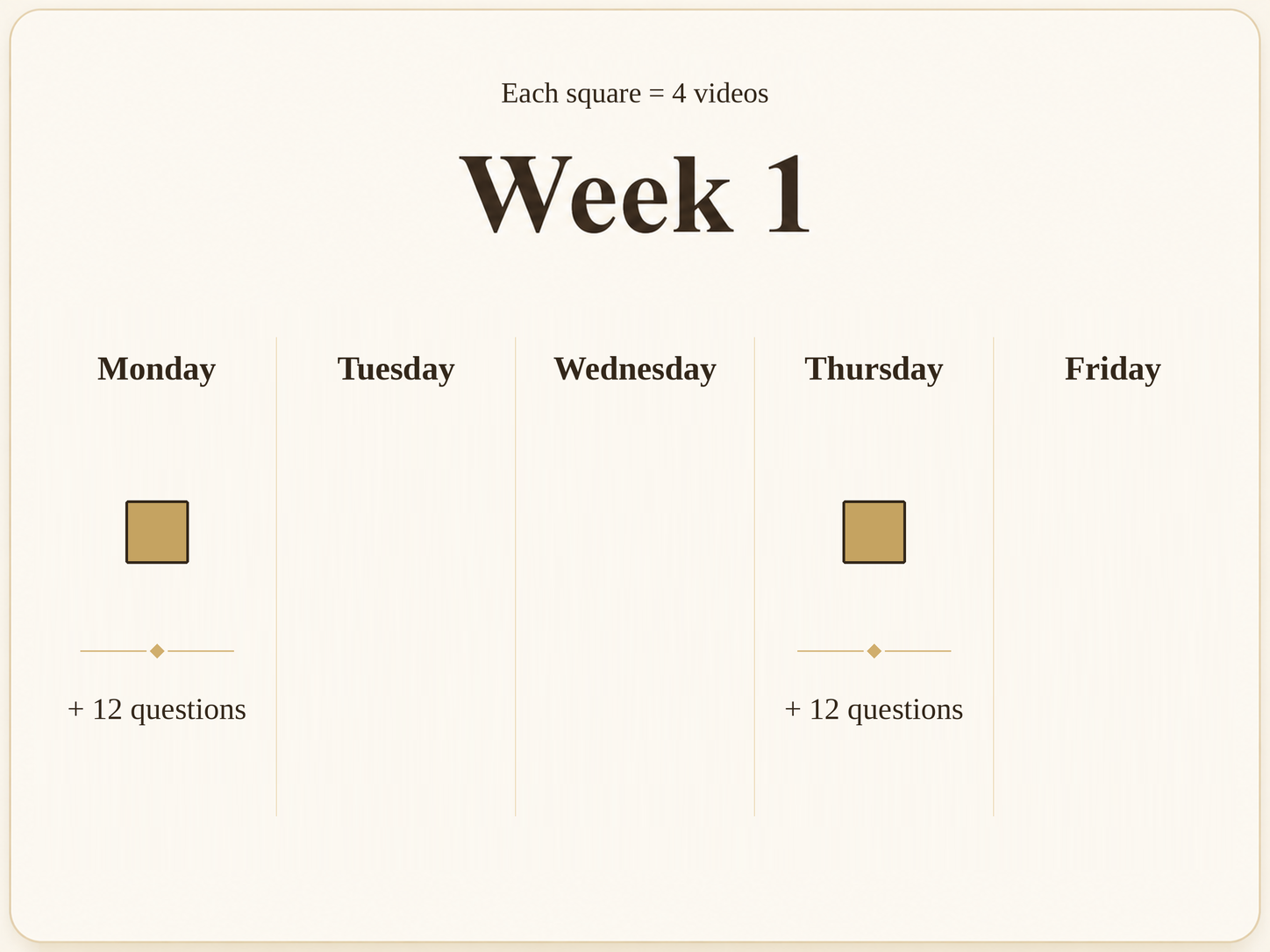
Learners learn the workflow, select resources, identify essential information, build conceptual understanding, and establish a manageable daily rhythm.
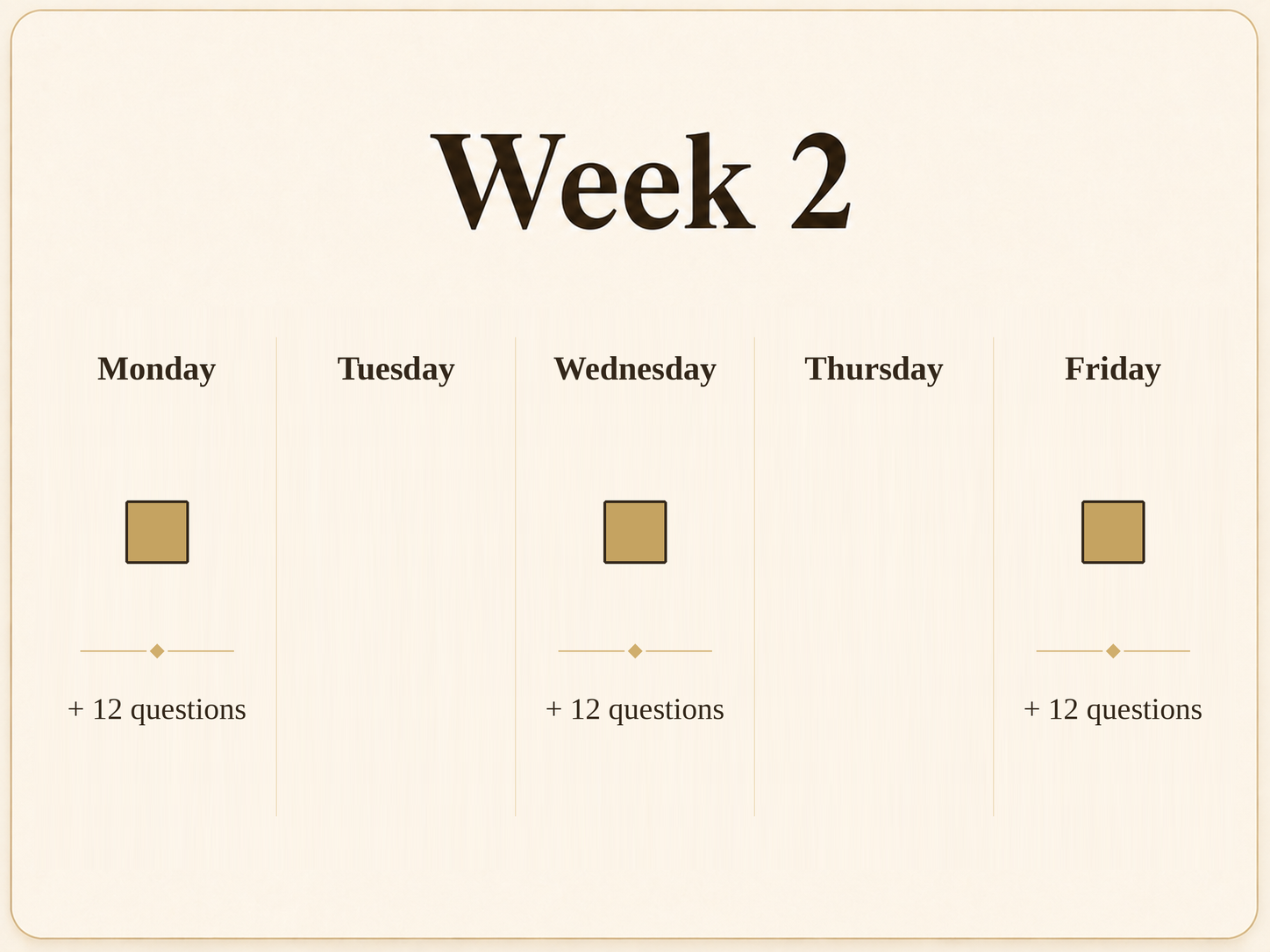
Learners begin consistent question-based application to determine whether understanding can be retrieved and used rather than merely recognized.
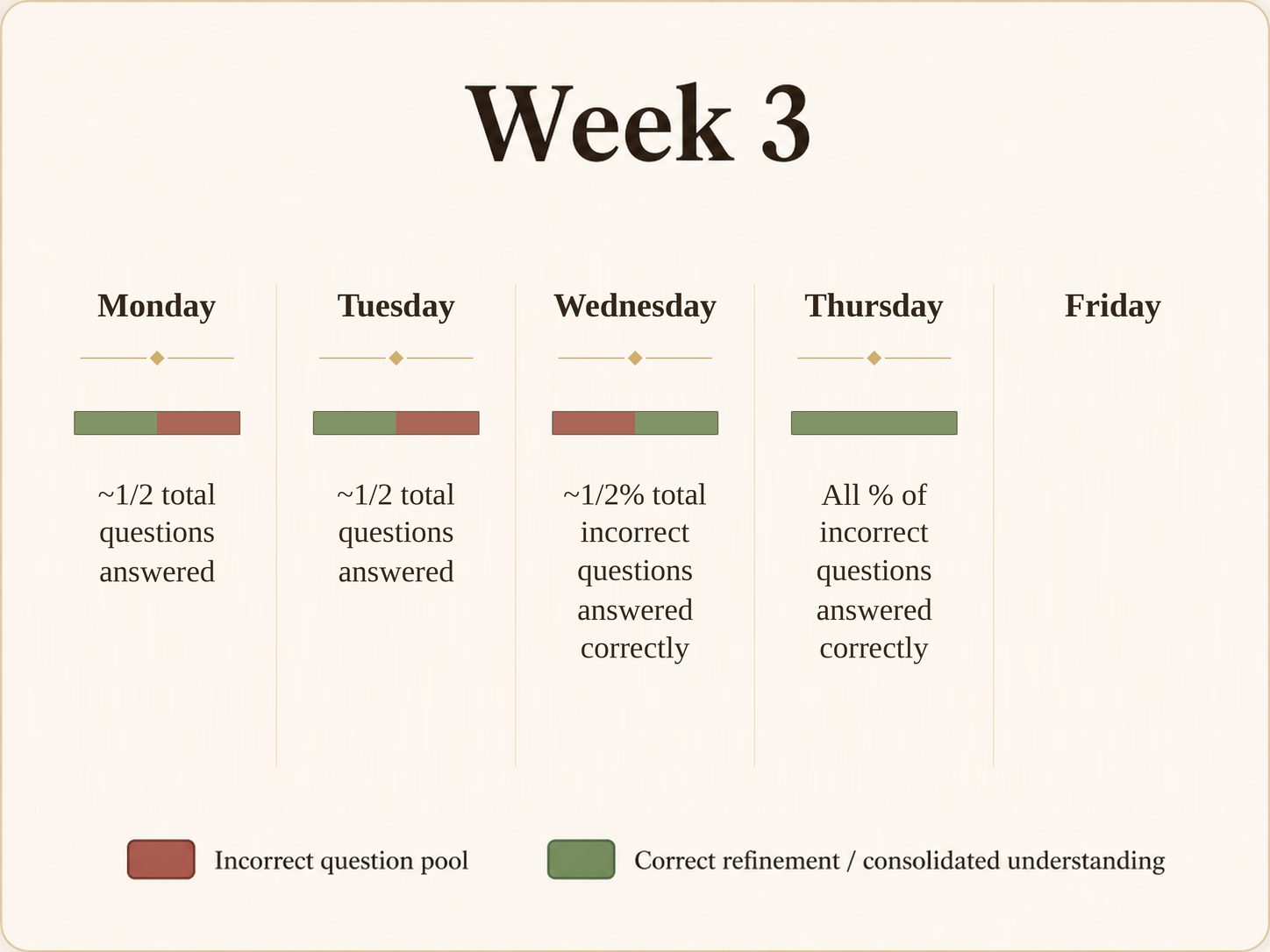
Learners revisit missed questions, identify where their reasoning broke down, and refine incomplete working memories until weak areas become more reliable.
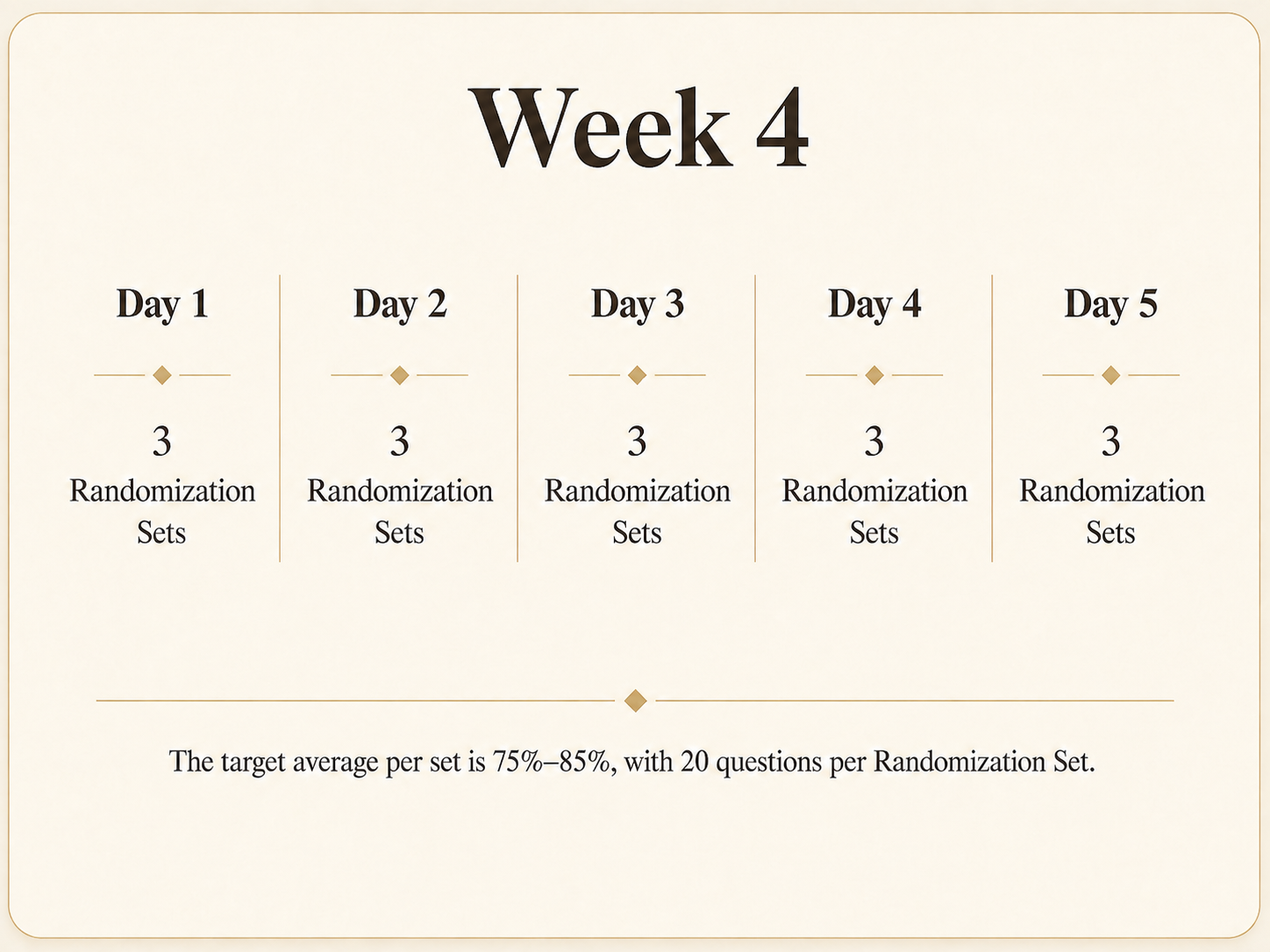
Learners complete randomized sets combining prior and new material in order to build confidence and competence in simulated exam environments.
Implementation
Every medical school is different. We understand how much work goes into building and managing your curriculum, resources, practice questions, and support systems. That's why we work with you through PASS to give your students a way to use everything you've already put together. They spend less time and energy figuring out what to do, and you get to spend more time using what you curated for them.
PASS can work around your existing curriculum, platforms, schedules, practice questions, study resources, and student-support systems.
We give students the structure for how to use those pieces together without asking you to redesign the curriculum you've already built.
We work with your institution to adjust how PASS is implemented based on the resources, schedule, expectations, and incoming students you're actually working with.
PASS gives students a repeatable structure they can follow without requiring faculty to recreate the same guidance for every incoming student individually.
We aren't trying to replace what you've built. We just help your students get more out of it.
Next Steps
We'll walk you through how we would integrate your material, pricing, answer any additional questions, and show you what PASS could look like at your institution.
Prefer to contact us directly? WangMethodofLearning
Terms & Privacy
Last updated: October 10, 2026
These Terms govern use of the Pre-Matriculation Academic Student Success system ("WMOL PASS" or "PASS"), offered by Wang Method LLC ("Wang Method," "we," or "us"). By using PASS, you agree to these Terms. If you do not agree, do not use the system. A separate signed agreement with a medical school or other institution governs that institution's license, implementation, and any terms that take precedence for its authorized users.
PASS is an educational learning and study-organization system. It helps students understand, remember, apply, and consistently use educational materials and tools their school already provides. It is not a medical-care service, a clinical decision tool, or a substitute for instruction, examinations, academic advisers, or institutional policies.
PASS does not promise exam passage, academic credit, retention, remediation avoidance, graduation, admission, professional licensure, or any particular result. Examples, testimonials, and pilot findings describe specific experiences, not guaranteed outcomes for every student or school.
Access is generally provided through a participating institution. You may be asked to select your school, enter an institution-issued activation code, verify an eligible email address through a one-time code, and use a registered device session. An activation code is for authorized enrollment and is not a transferable product key or permission to share access with others.
A WMOL account may hold more than one school or program enrollment when separately authorized. Records for different enrollments remain separate. Where supported, a user can have up to two active PASS device sessions and may need to revoke an old session before using a new installation. Do not share account credentials, verification codes, or device-session secrets.
PASS helps organize the use of lectures, question banks, study materials, and other educational resources. Those resources remain subject to the school's or third-party provider's own license and policies. PASS does not transfer ownership of, include, or guarantee access to third-party materials such as Lecturio content. External tools, including optional artificial intelligence services, are separate services with their own practices and terms.
PASS may store school enrollment information, completed sessions and weeks, and responses to weekly reflections or surveys. Your institution and authorized program operators may use appropriate records for educational support, administration, and approved evaluation, subject to their agreements and applicable requirements. If a program includes research, research consent and participant protections are handled separately as required. Using PASS alone does not replace informed consent for a research study.
For details on collection, authorized access, and retention, expand the Privacy Policy below.
Use PASS only for lawful and authorized educational activities. Do not impersonate another student, share enrollment codes, attempt to access another school's or learner's records, bypass access controls, disrupt services, scrape restricted content, or redistribute the software or its original materials without authorization. Nothing here limits rights that applicable law makes non-waivable.
Wang Method LLC or its licensors retain rights to the original PASS software, design, educational guidance, system organization, and original content. Subject to your institution's authorization and these Terms, you receive a limited, nonexclusive permission to use PASS for your own learning. Institution-provided materials and third-party works remain the property of their respective owners.
PASS may be offered as a free-to-download app while actual program access requires an institution's activation and license. A free Store download does not give unrestricted access to participating schools or proprietary learning systems. Institutional pricing, license length, renewals, and procurement arrangements are governed by separate agreements with the institution, rather than a consumer subscription purchased in PASS.
We may update PASS, fix errors, revise instructional material, or change supported platforms. Features can be temporarily unavailable because of maintenance, internet connectivity, institutional configuration, or outside services. Schools and Wang Method may suspend or end access when an enrollment expires or when reasonably necessary for security, fraud prevention, or serious misuse.
PASS is provided on an "as available" basis. To the extent permitted by applicable law, Wang Method LLC disclaims implied warranties and is not responsible for indirect or consequential losses arising from service interruptions, lost study progress, reliance on educational examples, or particular examination results. Nothing in these Terms restricts statutory consumer rights or liability that cannot lawfully be excluded.
Our Privacy Policy explains PASS information handling. Institution agreements, applicable student-record requirements, and separately approved research documentation may impose additional responsibilities. If these Terms conflict with an applicable mandatory legal requirement, that requirement controls. Texas law governs these Terms to the extent legally permitted, without overriding mandatory rights elsewhere.
We may update these Terms when PASS or its operational requirements change. The update date above will identify revisions. Where legally required, we will provide additional notice or obtain consent before applying material changes.
Publisher: Wang Method LLC.
Questions, access concerns, or support: [email protected].
Last updated: October 10, 2026
This policy explains how Wang Method LLC ("Wang Method," "we," or "us") handles information through the Pre-Matriculation Academic Student Success system ("WMOL PASS" or "PASS"). PASS is designed primarily for institution-authorized students. Its information practices are different from the individual subscription and device-linking features in other WMOL companion apps.
Depending on your institution and the features you use, PASS processes: your verified email address and WMOL user identifier; the school or program you select; enrollment and activation status; one-time verification events; completed learning sessions, weekly progress, and completion records; weekly reflection or survey responses, including optional text; and feedback you choose to send to support.
The app and backend also handle randomly issued device-session identifiers and credentials, authentication tokens, app settings, and technical information needed for account security and troubleshooting. Hosting and security systems may process IP addresses, request timestamps, device/browser information, and ordinary service logs. Do not include health records, patient information, or other sensitive third-party data in optional survey text or support messages.
When you activate PASS, you select an eligible institution, enter its activation code, and verify an email address using a one-time code. Depending on institutional policy, your email may need to belong to an approved domain or match a pre-authorized enrollment. PASS uses Amazon Cognito for account authentication and related Amazon Web Services infrastructure for authorized account and program functions.
The backend is designed to keep protected representations of activation codes rather than store raw redeemed codes in routine enrollment data. Supported clients store sign-in and device-session credentials using platform-protected storage. Never send a verification code, activation code, or private device credential in a support email.
PASS records progress so you can resume work and complete your institution's learning program. Weekly surveys or reflections can help identify where learners need additional support. Responses may be associated with your school enrollment and are not anonymous merely because an export replaces your name with a participant identifier.
School and program personnel may receive aggregated or appropriately limited data where authorized. Routine analytical exports are designed to use pseudonymous participant identifiers by default. Identified records may be accessed or exported only for an authorized function that requires identification, subject to the institution's agreements, permissions, and applicable requirements.
We process relevant information to verify eligibility and login; enforce access and registered-device limits; provide the four-week study workflow; preserve progress and survey responses; provide institutional support and appropriately authorized evaluation; troubleshoot technical issues; detect misuse; maintain security and service reliability; and meet legal or recordkeeping obligations.
We do not use individual PASS progress or survey responses to target third-party ads.
PASS may operate under agreements with schools or other educational institutions. Which personnel can access particular records, whether evaluation is part of a program, and whether any research use is permitted depend on the approved implementation and applicable requirements. Where research consent is required, that process must be handled separately. Downloading or opening PASS is not itself an authorization to use identifiable student records for an unrelated study.
Information may also be shared with vendors that operate the service on our behalf, with authorized support personnel, or where required by law or reasonably necessary to address fraud or security threats. We do not sell personal information.
PASS uses Amazon Web Services components for functions such as verified sign-in, application programming, data storage, email verification, service monitoring, and security logging. The website may be delivered through its hosting and network providers. Institution-provided resources and optional external study tools, including Lecturio and AI services you choose to open separately, have their own privacy policies. They are not part of PASS simply because PASS can be used alongside them.
We use access restrictions, authenticated requests, protected client credentials, and security controls appropriate to this service. Enrollment records are separated by institution or program. Survey answers and authentication secrets should not appear in routine application access logs. No internet service or device storage is completely secure.
Temporary verification or rate-limit records may expire automatically. School enrollment, progress, and survey records do not all have an automatic expiration date in the current system. The appropriate retention or deletion schedule must reflect the institution's approved program requirements, any applicable research commitments, legal obligations, and support or security needs. We will not promise a fixed deletion interval until one applies to the relevant program.
Operational logs may have different retention periods from educational records. Some independent records held by hosting, mail, security, or other providers may remain under their own applicable duties.
To ask about information reasonably controlled by Wang Method LLC, email [email protected] and identify your institution and the nature of your request. We may need to confirm your identity and institutional enrollment before responding. A school may also have its own student-record request process.
Some records cannot be changed or deleted immediately where approved institutional retention, research integrity, security investigations, or applicable law require their preservation. Removing the app from your device alone does not necessarily delete the enrollment, progress, or survey data stored on PASS servers.
PASS is designed for students entering professional and higher education and is not directed to children under 13. We do not ask users to submit patient records, protected health information, confidential case information, or other sensitive third-party information in this system.
Depending on where you live, applicable law may provide rights to access, correct, delete, or receive information, or to challenge certain processing. We will handle verified requests as applicable law requires and coordinate with the relevant institution where it controls the records.
We will update this policy if PASS adds material features such as new institutional reporting, cloud synchronization, analytics, billing, or other information uses. The date at the top will be changed to reflect revisions. Material changes will be communicated when required.
Privacy and support contact: Wang Method LLC at [email protected].